
Beginner’s Guide to Keyword Research
If you are new to keyword research, take it all in. If you know what keywords are and just want a refresher course, skim the first few paragraphs. Isn’t that what we all do now anyway?

What is Keyword Research?
Keyword research is the process of identifying and analysing search terms that people use to find information online. It’s a crucial step in content marketing, search engine optimisation (SEO), and paid advertising.
By understanding the keywords your target audience is searching for, you can create content that is more relevant and visible to them. After all, what’s the point of writing content that no one is looking for?
Understanding Keyword Types
To avoid confusion, let’s clear a few things up. There are several types of keywords that you should be aware of:
- Seed words/short-tail keywords: These are the initial keywords that you start with. They can be related to your business, products, or services. For example, your pet business’ seed words could be “pet food” “dog food” “cat food.”
- Medium-tail keywords: These are generic keywords with one or two words. They are often highly competitive, so it can be difficult to rank for them. Examples are more detailed such as “natural dog food,” and “cat food Reviews 2024.”
- Long-tail keywords: These are more specific keywords with three or more words. They are less competitive but can attract more targeted traffic. Examples include “top-rated natural dog food” “best budget cat food,” or “how to transition a dog to a new food.”
Top Tip: Long-tail keywords are great blog topic ideas!
Why is Keyword Research Important?
Keyword research is important for several reasons:
- Improved search engine rankings: By using relevant keywords in your content, you can improve your chances of ranking higher in search engine results pages (SERPs).
- Increased website traffic: Higher search engine rankings can lead to more website traffic.
- Better user experience: Keyword research helps you create content that is more relevant and valuable to your target audience.
- Targeted advertising: You can use keywords to target your ads to specific audiences.
The Keyword Research Process
That’s all great, but how do you find keywords? Don’t worry, it’s not as difficult as you might think.
Here’s a step-by-step guide to keyword research. This process will help you to identify keywords for your business so you can create an effective content plan.
1. Identify your target audience
Who are you trying to reach with your content?
- Consider their demographics (age, gender, location)
- Understand their interests and hobbies
- Identify their pain points and needs
- Determine their level of technical expertise
2. Brainstorm seed words
Think about words related to your business, products, or services.
- List out the core topics and themes
- Brainstorm related terms and synonyms
- Include industry-specific jargon and slang
3. Use keyword research tools
There are many free and paid tools available to help you find relevant keywords. Here are some of my favourite FREE SEO keywords tools:
- Google Keyword Planner: This is my favourite tool for keyword and blog topic research. Why not start at the source, right? Unlike other free keyword tools, this doesn’t have a daily maximum. You will have to create an account and answer some questions. When it asks you for payment, skip this part and go to the keyword planner. It’s all free and easy to use.

- Semrush: Similar to Google’s keyword planner, this tool provides you with keyword ideas, average search numbers, and competition density. The free version does have a daily 10-search limit but that’s still quite a lot.
- Ubbersuggest: Ubersuggest is a versatile SEO tool with a range of features, but its free keyword ideas tool is particularly useful. It provides valuable insights like search volume and SEO difficulty, along with other monetization-related data. While the free version has daily search limits, it’s a handy resource for occasional checks or comparing results from tools like Google Keyword Planner and Semrush.
- Answer the Public – This tool can help you generate content ideas based on what searchers or users may want to answer. The results also make great long-tail keywords. It’s like a bigger and better Google search. It’s great for writing up FAQs or question headers.
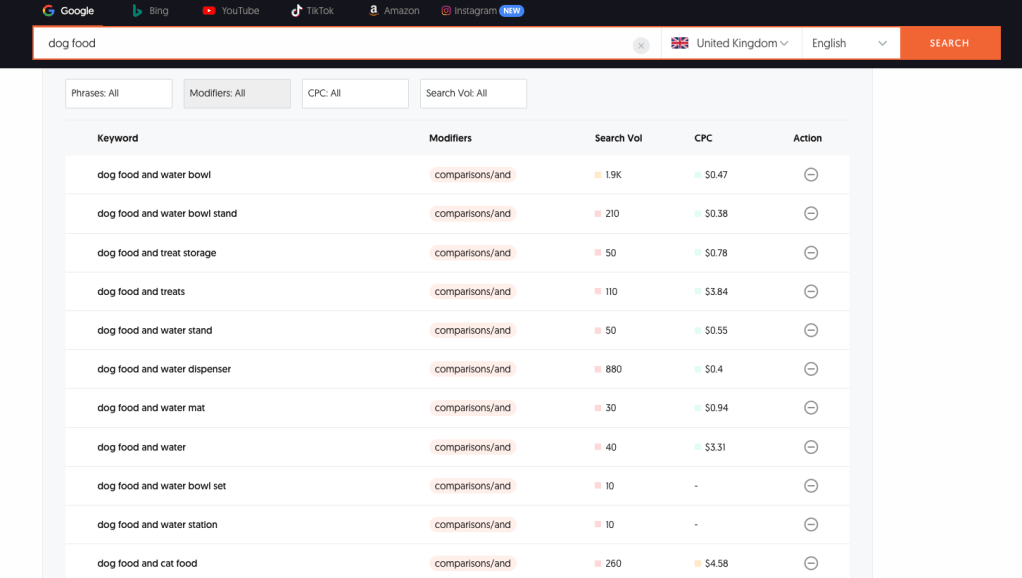
4. Analyse the keywords to format a relevant keyword list
Look at the search volume, competition, and relevance of each keyword.
- Prioritise keywords with high search volume and low competition.
- Consider the relevance of the keyword to your target audience and business goals.
5. Choose your keywords and organise them by search intent
Select the keywords that are most relevant to your target audience and have a reasonable search volume.
Organise keywords by search intent:
- Informational: Users seeking information (e.g., “how to start a blog”)
- Navigational: Users seeking a specific website or page (e.g., “best dog food delivery service”)
- Commercial: Users researching before a purchase (e.g., “best dog food for rottweilers”)
- Transactional: Users ready to buy (e.g., “buy organic dog food”)
6. Incorporate keywords into your content
Use your chosen keywords in your titles, headlines, meta descriptions, and body content.
- Natural Keyword Placement: Integrate keywords naturally into your content.
- Keyword Density: Avoid keyword stuffing; aim for a balance.
- Keyword Prominence: Place keywords strategically in prominent positions (e.g., headings, subheadings).
Tips for Effective Keyword Research
- Be specific: Use long-tail keywords to attract more targeted traffic.
- Consider user intent: What are people searching for when they use a particular keyword?
- Keep up with trends: Stay up-to-date on the latest trends and popular search terms.
- Use keyword research tools effectively: Experiment with different tools to find the ones that work best for you.
There are some really effective tools out there and AI can support with brainstorming but trust your own research too. It’s about understanding your audience and supplying them with the information they’re looking for.
By following these tips, you can conduct effective keyword research and create content that is more visible and valuable to your target audience.
FAQs
What is local SEO?
Local SEO is a set of techniques that can help your local business appear more prominently in unpaid, location-based search results on Google Search, Google Maps, and other search engines.
Do keywords need to be exact?
you don’t need to use the exact match of a keyword; however, it does help. We’re using headers with a version of the keyword or phrase, making sure it’s in the URL, the title, and alt text of relevant images.
How do I get good at keyword research?
Know your audience, use keyword research tools, learn from your competitors, trial and error.
What are long-tail keywords and why do I need them?
Long-tail keywords are specific phrases with lower search volume but less competition. They’re perfect for driving highly targeted traffic and boosting conversions.
 nualamchughwrites.com
Leave a comment